15 December 2008
The belén de cumbre
 Yesterday was another day with the mountain group, this time it was their Belén de cumbre. A belén is (apart from being a fairly common girl's name) a nativity scene. The group head up to their little cave on the Naranco (it's got a plaque and everything), place a new nativity scene and then sing a few carols (which is a bit like playing 'one song to the tune of another' for us, with the exception of the one about how much the fish in the river are drinking, no idea about that one). As the nativity scene is being placed, a few cakes are passed around, casadiellas, fizzy cider (pommagne really, but nice).
 We had every type of weather too, from warm sun to hailstones and lightning, oh and snow on the top.
After the walk we headed to Casa Gervasio for what the president of the group had called 'comida seria' (serious food). It was too: fabada followed by carne gobernada (which is like carne guisada (stewed meat) only with the addition of red peppers) and puddings, which kept coming. The folks we were sitting with were very keen that we tried everything, and there was much refusal citing 'I'm full', 'I can't eat any more'.
And of course there was sidra, wine and orujo... Then trophys for all those who had done 80% or more of last year's walks (so not me then)... then dancing.
This was all finished off with us all in a circle, holding hands and stepping forward and back, raising hands and (those who knew the words) singing along to a tune of Asturian pride.


11 December 2008
The days of slaughter
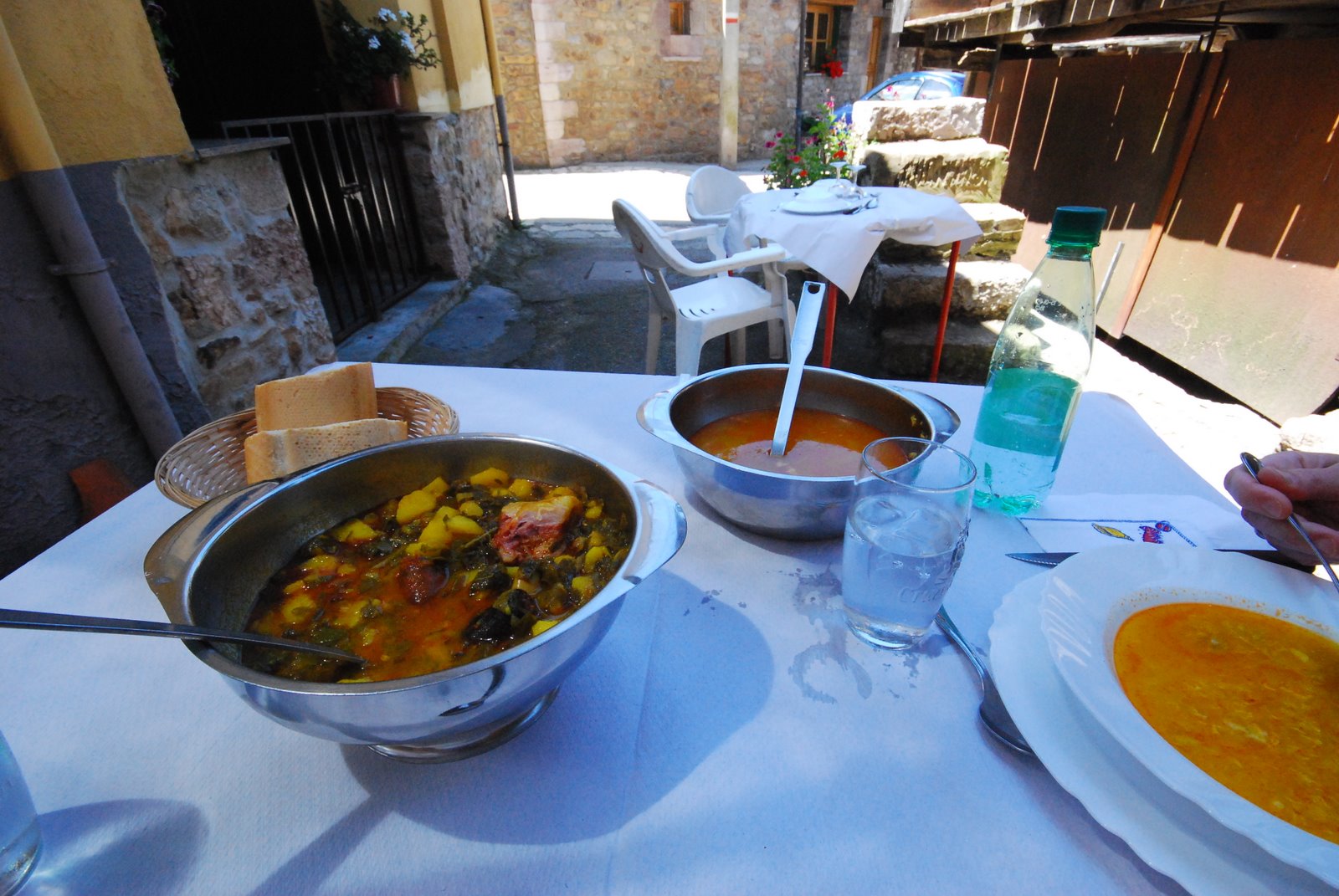 On the way back from skiing we stopped to eat in a place called Felechosa, high in the Aller valley. Most of the tables in the restaurant were reserved and there was a set menu on offer. If we didn't like what was on offer, we'd have to go to some other town, the waitress said, because this was one of the Jornadas Gastranómicas de la Matanza. Literally the gastronomic days of the slaughter, traditionally, the time of year when the families killed one of their pigs (or, as was common enough, their only pig) and then made months worth of food from it. The menu was straightforward enough:
First of all an appetiser of Manitos de cerdo
(pigs trotters, well the porky gelatinous parts of trotters, rather a nice flavour but definitely an acquired consistency).
Pote Asturiano con compango casero (chorizo, morcilla, costilla y lacon)
Which is the traditional beans, potato, kale/greens with a chorizo, black pudding, pork ribs and belly pork (a bit of a pig theme then).
Picadillo Casero
Lomo Adobado Casero
These two came on the same plate, hiding some chips, picadillo is the filling for chorizo, it was quite spicy, and the lomo is nice thick slices of pork loin. (Remember, it is a pig they slaughter).
Panchón for dessert, which was a new one to all of us, but essentially is breadcrumbs from spelt bread, fried in butter and sugar.
This was not health food.
Accompanying the meal was wine, soda and following it was a chupito of orujo de arándanos, blueberry based alcohol.
I'm still full now.
09 December 2008
skiiiiiii
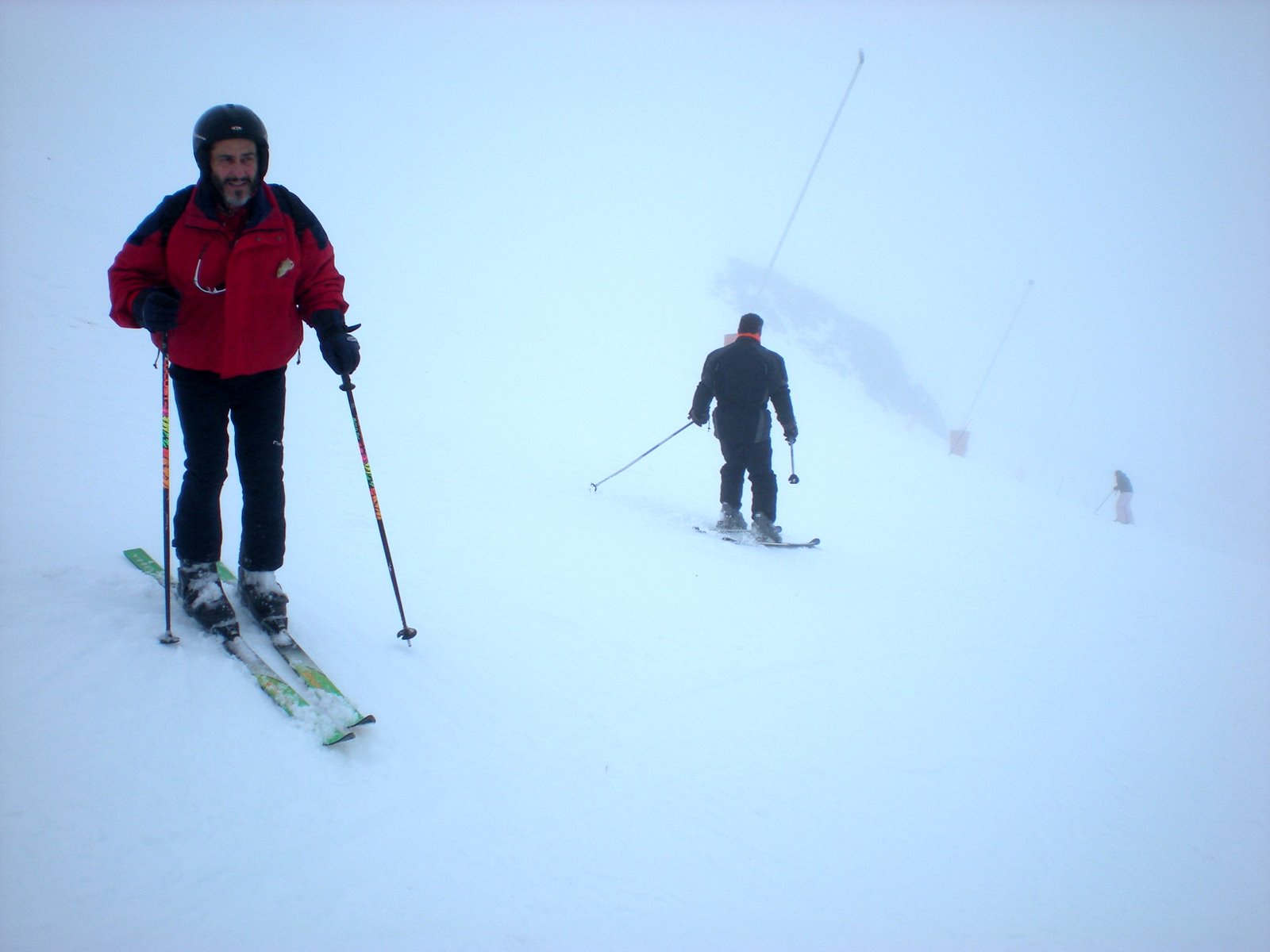 It was foggy, visibility was, shall we say, limited, flat light, a touch of drizzle. The snow was heavy, sticky porridge and there were too many people but none of that really mattered because I was able to ski. I've been a little concerned since I snapped my ligament three years age, haven't skied since. The surgery was 15 months ago so technically my knee should be fine. Still, there was that nagging doubt.
So when Pompeyo said on Sunday's walk that we should go skiing on the Monday, taking advantage of the bank holiday, we said great.
San Isidro is a small ski resort in the north of Leon, an hour's drive from Oviedo. There are 27 runs, mostly blue or red, and a ton of people all with the same idea.
Liz decided not to ski and kept Carmen, Pompeyo's wife company, as she doesn't like skiing in these conditions and they're not conditions to give Liz any confidence ahead of our French adventure.
I rented my boots (€7), paid for the half day lift pass (€16) and borrowed some skis from Pompeyo. It went pretty well, the first couple of runs were a bit sketchy, especially when we went down a red by mistake, thanks to the almost zero visibility, but later on it got a bit better. Except for the other red we went down by mistake where I failed to see a dip and did a face plant at speed, leading to a couple of minutes with snow held to my nose to stop the bleeding. It wasn't just me, Pompeyo fell a couple of times and we decided not to push it because he's off to the Pyrenees for a week in a few days.
So the knee worked and I enjoyed it. The resort is tiny but there is a bus from Oviedo, so we can take advantage of it over the next four months. It'll be nice to go back and actually see the mountains while we're skiing down them
04 December 2008
Time for...
Time is different in Spain. Most people know about the customary late-nightness but it goes further than that. I was asking some students about what they did at the weekend and their answers were confusing. They went to a party which began on Friday afternoon and finished on Friday morning. So we discussed it a little:
Madrugada, often translated as early morning (sometimes dawn) is often used with what we would consider the day before, so Friday Madrugada is for us, Saturday Morning (between midnight and 3 or 4am). Although it is commonly used for early morning as late as 10pm (such as today, when Liz met someone at the shops they said what an early riser she was (que madrugadora!)
Mañana, also morning, usually refers to the time from dawn to lunch, which could be 2pm or later, so sometimes I get confused when students say good morning.
Tarde, afternoon, which runs from after lunch to dinner, so until 10pm. When something starts in the afternoon here, it's often at 6pm.
Noche, night, usually from 9 or 10pm to midnight (after which it's madrugada). The prime time for TV programmes is 10pm, the equivalent of newsnight begins at around 12:30am.
It takes a long time to get used to the changes, it's still surprising to hear our neighbours chatting away and watching telly at 2am on a week-night... according to the newspapers, the Spanish sleep less than any other nation, because after those late nights, a lot of them still get up and go to work for 8am.
¶ 10:24 AM 0 comments
