30 May 2008
Padua... wasn't Anakin Skywalker one of those
Padua/Padova is about half an hour away from Venice, and as a consequence, the majority of tourists seem to drive past it. This is a good thing, as an abundance of tourists is a pain... even though we constituted two more. We saw quite a few groups during the day, being led past the 12th century market (the building I think is a little newer than that, but not by a whole lot) or being taken to rub the old bones of St Antony in the basilica, or at least the back of his sarcophagus. Padua also has miles of covered pavements, porticos, for whatever reason. The weather is not going to be a problem there because you can traverse the entire historic centre of the city under cover. We took the tour of the piazza del bo, which is part of the university. 1222 they started here, so there's a history of learning. The reason we did the tour is that they have the worlds oldest dissection theatre. It's tiny, a room the size of a small bathroom with six steep tiers above it in an inverted cone shape. They had a special dispensation from the pope to let them cut up criminals. That and sitting in the lecture hall that Galileo lectured in (spruced up a bit, some paint, some additional parquet flooring) were pretty good highlights.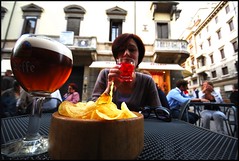
As for the Padovese, well, they like their Aperol spritz, it's an aperitif similar to campari, which they also drink in huge numbers. They also seemed to flock to one stall at the side of the market and when we looked they were going mad for octopus. Simple boiled octopi, we asked for a small one, and the stallholder deftly sliced the head in two, scooped off the beak, took out the bits you shouldn't eat and chopped up the rest. He drizzled it with olive oil, a bit of parlsey and there it was, waiting to be polished off by skillful use of toothpicks. It was lovely... mmmm octopus brains... you can taste the intelligence.
¶ 9:46 AM 0 comments


29 May 2008
A mini rant interlude...
So with time to kill in Barcelona, I went to the movies. Indiana Jones and the tediously long title... I wasn't expecting greatness, I've seen some reviews and Anne hit the spot with her blog entry. But, but.... BUT oh my the physics... 
Okay, first... lead lined fridge, great find Indy. Surviving that rolling around, bouncing, tumbling and stopping very quicky. I think he carries a full body airbag in his man purse.
And worse, and this had me laughing out loud. The crystal skull itself, it's magnetic, it can attract iron filings (or gunpowder it seems) from a looooong way away. The best bit though is it only attracts metal objects when the special effects guys remember. So as soon as they pull their guns/swords/knives/dogtags away, the magnet forgets about them like a particularly stupid dog. And even worse John Hurt had a magic anti-magnetic blanket that blocked all of the magnetism when it covered the skull.
Of course, I may just have missed the explanation because the film was in Spanish... but I don't think so. I'll wait for Insultingly Stupid Movie Physics to notice.
¶ 10:10 AM 1 comments
28 May 2008
Take the strain
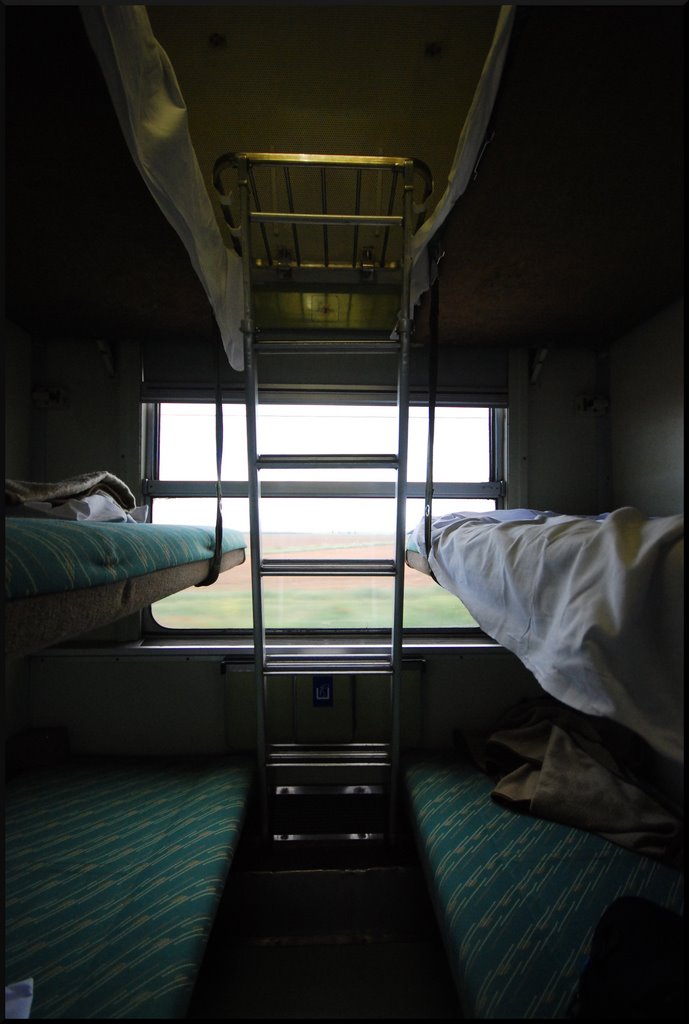 I've just got back from a long weekend visiting Liz in Italy. I'll write something about the visit soon, but first a word about the French... merde! Those work-shy-cheese-eating-surrender-monkey-striking-railway-upsetting French... we love 'em. I took the train to Italy, well, three trains, two overnight. First from Oviedo to Barcelona (12 hours or so) which went without a hitch, my first time using couchettes, or litera as they call them here. Six to a compartment, six narrow bunks and thin blankets and cotton sheets. I did get to talk to a maoist gnome (or rather I was talked at by a maoist gnome... but that's for a future post... the one about the people you meet on trains) but I also slept quite well.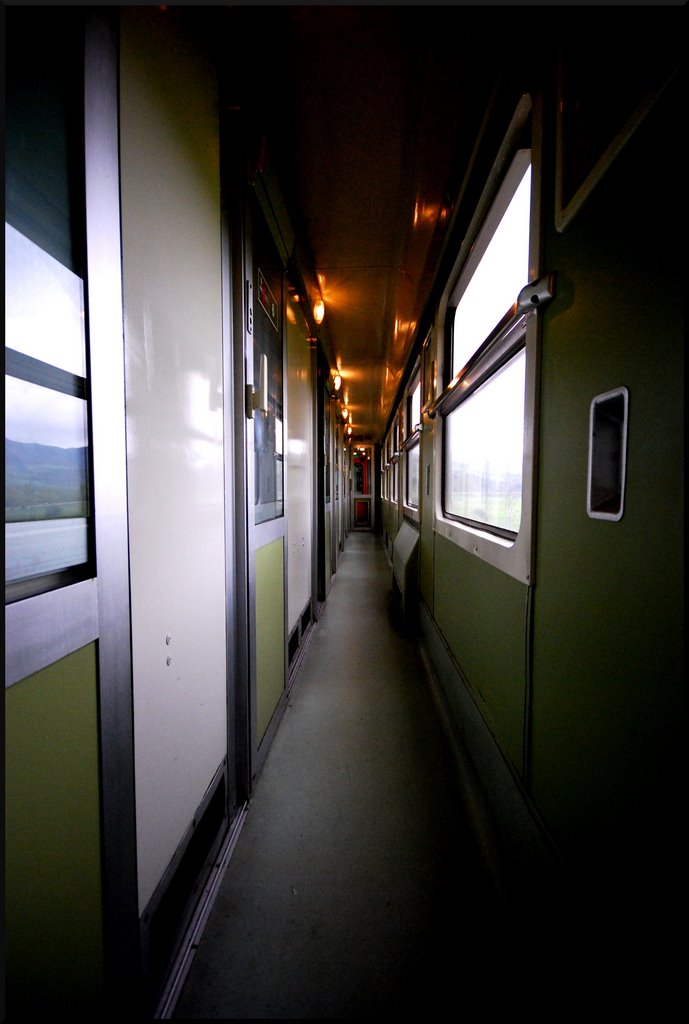
After a day in Barcelona I got another trai... waitaminnit... that sign says (in Catalan and in Spanish) Due to a French train strike the service to Milan will be by bus. BUS! Bloomin' French....
I ended up having to explain about the strike to a few rows of disgruntled non Spanish speakers (Japanese, Canadian, American) all of whom had just followed directions and gestures and now found themselves inexplicably on a coach. And not a coach like those lovely Argentine ones, oh no... Ordinary, upright seats, no blankets. It was an uncomfortable night, and we were woken early by the flashes of the Japanese as we drove through the Alps at dawn. It looked lovely but I would have preferred a bed. And the coach took a couple of hours longer than the train would have... so fifteen hours of cramped neck ache...
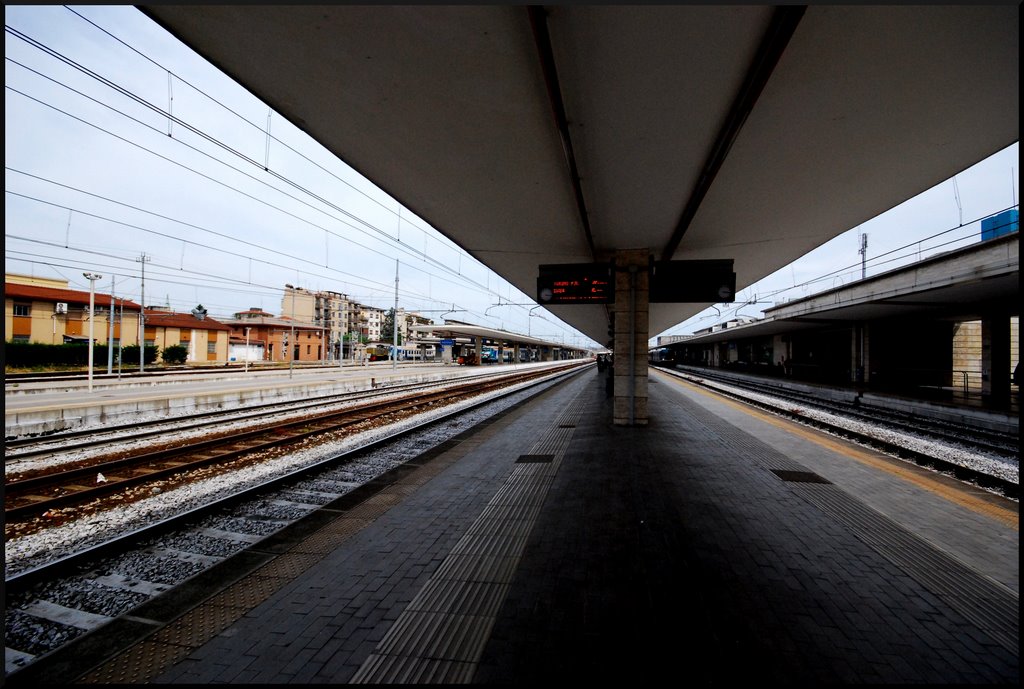
The third train was from Milan to Padua (Padova as the Italians misspell it). Milan station is the single most perfect example of facist architecture I've ever seen. It's enormous, and designed to impress. 'Well, at least he made the trains run on time' sprang to mind. This train was late... only by ten minutes but that's enough to be a metaphorical two fingers to Il Duce in my book. I met Liz at the station in Milan, she had arrived from the airport not long before I decoached stiffly.
Still, the return journey went without a hitch, and let me tell you, I really did miss out on a bed on the outward leg. The trenhotel Salvador Dali had four proper beds to a compartment, wide enough to roll over without peril, propper mattresses too, not just hard cushions. It's a fine thing to go to sleep as you roll into Turin, and to wake up as you roll out of Girona and head to the bar for a freshly made coffee (hello british rail operators: even the trolley car in italy had an espresso machine) and a sandwich made with fresh bread. The only downside is the fact that it took me two days, but if you have time, it's the only way to fly. ¶ 3:48 PM 2 comments
21 May 2008
And in an unrelated photo...
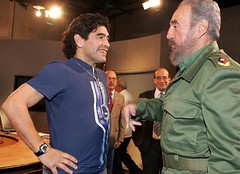
One of the things I like about teaching English, especially to adults, is that you get to learn stuff you never even thought about before. One of my students, who works for a big business software house, was telling me about his relatives. For some reason we got to talking about the first dead body we ever saw (it's a conversation class, so we generally just do a lot of conversing, and you can cover a lot of ground in an hour and a half). He said his was his uncle, who had been a diplomat, and who had been thrown out of Cuba in the late fifties after slapping Fidel Castro during a panel discussion live on TV in South America. Another told me he might not make the next lesson because he had to go to Cadiz in the south because he's the quality manager for an arms manufacturer and he has to go and supervise the firing tests... he said that they fire shells of up to 40km range, straight out into the sea, and that the fishermen in the area love it when they do live firing exercises because it makes the fishing just a matter of scooping up the fish afterwards.
¶ 9:52 AM 0 comments
19 May 2008
Another Sunday, another outing
We started early, the coach picked us up at 6:45am, most people on the street seemed to be going home at that time, or heading for a last drink before bed. Not us, we were off for another day in the mountains. The route this time took us from the hamlet of Soto de Sajambre up into the western fringes of the Picos de Europa and north to another hamlet called Amieva. The route followed, in large part, an old Roman road and I'll say this for those pesky Romans; they must have had very grippy shoes. I can picture it...
Marcus: Hey Julius, how's it going?
Julius: Oh, you know, not bad... for Iberia, I thought it would be sun sun sun but it seems to rain every day here. And the locals... ay all they think about is apples and cheese!
Marcus: Tell me about it. And the boss wants another road building. He's sent me the specs, here, look.
Julius: One RomanTM road, from here to there, but he's specified smooth limestone blocks, has he been here?
Marcus: You know the management, he's directing us from his beachfront villa in Malaga. I think he's forgotten about rain.
Julius: But these blocks will be lethal in the wet. The legions'll kill us, if any of them get down alive.
Marcus: Hmmm, I've been thinking about that... what do you know about vibram rubber...
Julius: I always said you were ahead of your time ...
Seriously, the route was pretty slippy on the way down, smooth wet limestone blocks. Other than that, we had sun until we were at our high point, so we got some good views, I participated in the massed umbrella parade on the way down, and I was pleased to find that each time it's less and less like a day-long oral exam in Spanish. Once again, Pompayu helped pass the time on the coach trip with a wide ranging conversation taking in Ernest Rutherford, Sherlock Holmes, limestone geology and the current state of pensions in Spain. Quite an interesting chat and a route to be repeated (autumn would be a good time). ¶ 9:37 AM 1 comments
15 May 2008
Martes de Campo
The local freesheet said that Tuesday had been marked on a lot of calendars since the beginning of the year. It's called Martes de Campo (or La Fiesta de la Balesquida, or el Día del Bollo). I asked a student a while back what happened and she said that you go to the country and eat a Bollo, a bread roll stuffed with a chorizo, you drink wine or sidra and... well that was it really. At nine this morining there were some really loud rockets from the park two blocks away, that carried on every hour or so until 2. In the park the Balesquida was underway, this, I gathered is a form of skittles/bowling where the solid wooden ball is thrown underarm, high into the air, towards the skittles, which are in a set on sand. The ball is thrown with a spin and doesn't bounce very much. It looked pretty hard. There was a lot of folk music, a few marching bands wandering round the park, the members of the Oviedo Balesquida club had a huge marquee and were dishing out Bollos and wine like there was no tomorrow. The paseo del Bombé (the wide French style boulevard in the park) was packed. Young and old were tucking into their Bollos, chatting away, having a fine time. And it's only a holiday here in Oviedo. If you live here and work in Gijón for example, you're out of luck... but you'll get your holiday some other time.
The Bollo I had was lovely, warm and the chorizo juice was like blood from a fine rare steak... I needed paper towels for my greasy greedy chin...
I think, like Jorge said, we're gonna need a thicker rope.... ¶ 6:06 PM 0 comments
14 May 2008
It's good when mates visit
Anne and Noel came for the weekend (if you're reading this blog and you don't know who they are; who are you?). It was great to see them and I think they had a good visit, it's not that we had a checklist prepared but I could develop one for the weekend Asturias experience.
Drink Sidra, check;
eat fabada, check;
visit the mountains, check;
visit the coast, check;
eat something with chorizo in, check;
eat fine seafood (in a place once visited by Woody Allen), check;
drink Rioja and figure out it's not all like the stuff we get in England, check;
eat your breakfast in a bar, check;
narrowly avoid collisions with boy racers on windy mountain roads, check;
see how umbrella use is endemic, check;
To be honest I didn't go to the coast with them because I was a little under the weather (and I had to work) but Anne came back with tales of Horreos (pronounced 'orri-oss'; those square barns on four legs that dot the countryside), pipes and medusas (the spanish for jellyfish).
We did a couple of walks at the weekend. One was the Cares Gorge in the Picos de Europa (I had planned something higher but it was pretty cloudy and the forecast was for rain, I did not want to spend the whole day with zero visibility). It was pretty wet, although stunning, as ever. My book of walks and climbs in the Picos says that you should do the Cares Gorge no matter what the conditions are, because you're guaranteed a good day out. It's about 11km each way, with a stop for lunch in Caín that was definitely welcome at that point... well it let us go from sopping to merely wet before we set off back. I don't have any photos because I looked at the forecast and left my camera in the flat (Anne blogs about it here).
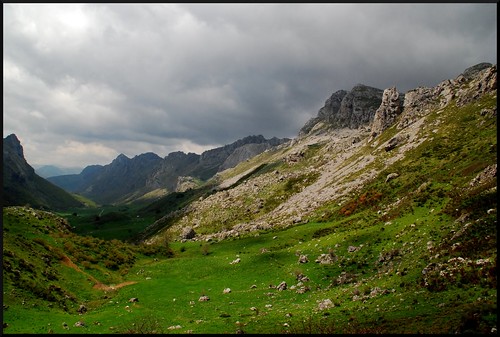
The other walk was up to a lake called El Lago del valle in the Somiedo national park. I had planned a longish walk from one of my guidebooks and the walking group folk had given me a colour copy of the area on a 1:30000 map. We set off a little late and did a slightly shorter version but it was still really enjoyable. After we negociated a few cows on the path (I'm always worried by cows, especially when they have calves with them, as these did. They always look like they're just waiting for you to put a foot wrong) we ascended one side of a large valley to it's head, where there was a big tarn. The tarn had been extended, it had some additional walls at the front. On our return route, along the other side of the valley, we saw old aqueducts collecting runoff water from further down the valley and distributing it to the tarn. The valley was full of brañas, thatched cabins that were (and by the looks of it in some cases, still are) used by vaqueros (that would be cowherders, or maybe cowboys) who used to come from the coast and spend the summer with their herds up in the high meadows. ¶ 9:39 AM 1 comments
07 May 2008
A salutory lesson
I joined the Grupo Naranco for a walk in the Picos de Europa, it was a walk I'd done before, the first I ever did in the Picos in fact. We started from lake Ercina, and walked through the fantastic limestone valleys up to a high mountain meadow. We had good weather up to then but behind us clouds had started to build. We had planned to go up to the top of Jultayu, another couple of hours and there was a good deal of discussion about whether we should. In the end 20 of us did, and we climbed the steep slope slowly, keeping a wary eye on the clouds, which disappeared for a while, only to return in force. 
We made it to the top above the clouds and after a quick sandwich, turned round and descended. During the descent the heavens opened and everyone put on their wet weather gear while thunder rumbled around us. It was a tricky descent, limestone is rather slippery in the wet and there's lots of it in the Picos. Once we'd descended from Jultayu we started off back to the bus, the rain kept on, but lighter. The problem was now the mud, the paths were rarely level and the mud was slippery. It took as much care to stay on your feet on the paths as it did to come down the mountain.
I was wandering along a little ahead of one group of people, a little behind another. As I got to the lake, the starting point, clouds came down. By the lake the path disappears and you have to cross a smooth grassy meadow. I was walking in a straight line for a car park I knew, so I carried on walking. Suddenly the ground sloped steeply upwards, I realised I wasn't where I thought I was, and worse, I couldn't see, or hear anyone. 200m from knowing where I was and I was lost. I shouted and listened: nothing. I was towards the back of the group so I knew they'd miss me pretty quickly so I decided to stay where I was and let them come to me when I was missed. They did, but it took half an hour because I couldn't hear their shouts or whistles as I was further from the path than I thought. Eventually I heard a shout and responded. It was a good lesson in mountain safety... or rather the reverse, and a little embarrassing, so close to the finish.
Everyone was fine though, even though I had delayed them setting off for home, no pasa nada, they said, it's the clouds around here, it's your initiation, did you enjoy the rest of it? I did enjoy the rest of it and I spent the journey home discussing etymology and politics with a Jean Reno lookalike called Pompayu, who looks like he's 55 but is 65, and likes to talk, which is fine because I like to listen (it's good practice and my speaking is not up to deep philosophical stuff yet). Next one in two weeks... I'm hoping for good weather this time.
¶ 9:22 AM 2 comments
06 May 2008
Fried Milk at the Ascencion fair
This weekend there are a few bits and pieces going on thanks to it being the ascension. In the cathedral square there has been an invasion from the countryside. There are stalls selling leather, silver, rides on donkeys and horses. There are cows being milked, horseshoes being forged, the sound of the pipes all over the place. All of the stallholders seem to be in traditional dress (which includes studded clogs: wooden ones with four great big studs like pillars... I saw someone in a field wearing them when I went to Quiros climbing with Jorge, studs are a good idea in the mud I guess). I wandered around with my camera, bumped into one of my students who was very pleased to tell me that now I had to speak spanish.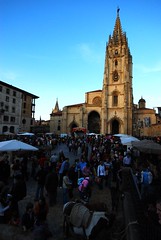
In the next plaza there were more stalls, only this time food. I wandered around trying all the stuff that my Asturias guidebook had mentioned, like the Buckwheat 'escanda' bread, frixuelos (pancakes), chorizos and cheeses from lots of different valleys. I ended up getting some lovely creamy cows milk cheese called uno de los caserinos and a boar chorizo which has a fine kick. I also tried something I'd seen mentioned in a couple of places, leche frita, fried milk. It's sort of a set milk (like a custard but without vanilla) that's then battered and fried with a sweet crunchy batter with cinnamon. It was one of those things you know you have to eat when you see it and it was lovely, soft and creamy and bad for the teeth, I had to wash it down with some sidra dulce (apple juice as far as I can tell).
Up above the railway station there was another big group of marquees, one of which was full of cheese sellers, and another which was put up by the Brotherhood of cheesemakers (I want an application form, they have cloaks and stuff). There was a lot of chorizo, a lot of cabrales cheese and some anchovy specialists looking out of place (I bought some, it was so nice, without being salty).
According to the guidebook there are seventy or so food festivals, which, as the mathematically astute will know, works out to more than one a week. Next week, for example, in Santoloaya de Cabranes they're having the 24th festival of Arroz con Leche; that would be rice pudding... Not only that, it's a three dayer, starting on Friday. There's a €200 prize for the best pud, this is not Ambrosia country here... (have a look at www.cabranes.es if you like). It's not just food, there's a five day gold panning competition in July among other things.
¶ 9:40 AM 2 comments
03 May 2008
A classic of the genre
I got a text from Jorge, asking if I wanted to come along on a classic 250m route. So I said yes. The route's on a crag called La Mesa, one of three rocky outcrops (outcrops which are 300m high) topping out at 1922m. Xuacu and Jorge picked me up at 3:30pm and we drove south, turning off the main road into deep deep valleys and winding our way up narrow roads to where the snow was still thick in sheltered dips. We went through a gate and Xuacu said welcome to Spain, now we can eat paella... We were deep in the cordillera Cantabrica which separates Asturias from the rest of Spain (the Asturians seem to like it that way).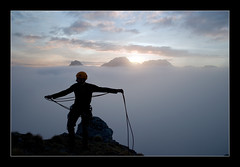
The climb itself was called Gran Diedro and to give climbers an idea of the style, the first ascent was 1969. It's old school. Climbs here are graded III IV and V plus and minus, then 6a, 6b, 6c, 7a and so on. But there's a biiiiig difference between a bolted sports V and a 1969 pitons and beards V. There is a sense of safety in sports climbing that is conspicuous by its absence on big routes like this. Jorge offered me the lead and I said no, not this time, I haven't climbed with trad gear for a while, not on a multipitch. So he led off and there was grunting as he wedged into an off width chimney, a task somewhat complicated by his backpack.
Xuacu went second and had a bit of an epic trying to get out of the chimney, he had trouble with his rucsack and it looked bloomin' awkward. He eventually decided it wasn't for him and came down. I thrutched, squeezed and scraped up the first pitch and, as I tied in to the belay, congratulated Jorge on a good lead, it felt a little harder than the sports routes we did a few weeks ago. He carried on and there was more grunting, a little slipping and the noise of the odd carabiner being clicked open and closed. There was not a great deal of postitive stuff for the feet on this climb, and in a few places, precious little for the hands either. I was rather glad it was Jorge on the lead and not me, then at another belay he said this was only his second time leading a classic like this. I was gobsmacked. He was doing a fine job, quick into the belays and very safe so I was enjoying this return to heights (I think only Gubia normal in Mallorca is longer in my climbing history). The other thing with multipitches and, in my limited experience, limestone, is that you often find yourself faced with a choice of grass filled hole for you foot or blank wall with a little nubbin of something that you'll have to smear on, and the choice is often dictated by the quality of the handholds. It makes for interesting climbing (Jorge's blog entry is here and it has more photos).
We topped out at 9pm, clouds had obcsured all but the highest peaks (that's Jorge in the photo, with peña Ubiña in the background). My throat was dry as dust, I blame the altitude. We found the route down as dusk fell, and walked down the steep zig zag path into thick fog. A fine day, and hopefully we can come back and make sure Xuacu gets to do it next time.
I am so stiff today it's not funny. Okay, it's a bit funny... ¶ 11:26 AM 2 comments
